
Marian Maguire
Labyrinth
22 September – 10 October 2026
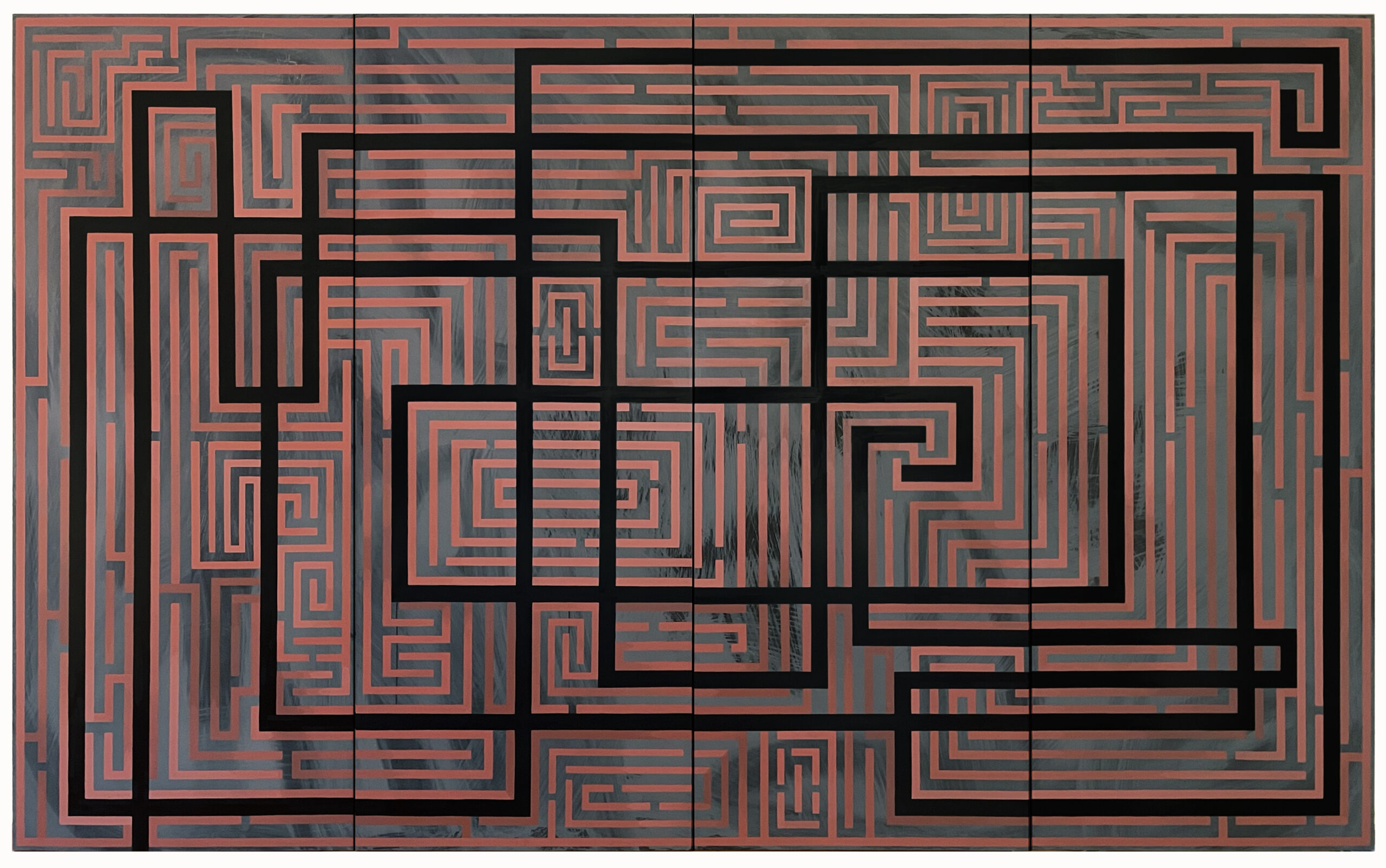
Labyrinth (2026), acrylic and polyurethane on 4 panels, 1980 x 3240mm,$25,000
Theseus killed the Minotaur in the Labyrinth. He couldn’t have done it without Ariadne who gave him a ball of wool, a sword and a plan. Then he dumped her.
It wasn’t the plot that motivated me to work towards this exhibition, it was a description I read about 20 years ago that has stayed with me since. Theseus creeps through the Labyrinth, his senses prickling with adrenaline, he listens for the snorting of the Minotaur, dangerous exhalations hang in the air. My father also told us this story and I wonder if it was my child’s mind that remembered the shallow breathing, the listening, the hunting and hiding. We played Labyrinth. I imagine myself again pressed up against a wall listening as one of my brothers or sisters stalks around the corner. Am I Theseus? Am I the Minotaur? I don’t know. I’m just hoping to survive this deadly game of hide and seek.
The ancient myth is set on the island of Crete, realm of the tyrannical King Minos. He imprisoned the Minotaur in the Labyrinth, an elaborate maze designed by the artist/inventor Daedalus (who later built wings of wax and feathers so he and his son Icarus could fly but that’s another story). The Minotaur was a monstrous creature with the body of a man and the head of a bull. How could such an abomination have come to exist? It was Minos’s fault. He’d failed to sacrifice the Cretan Bull as promised and the gods, angered, cursed his wife Queen Pasiphae to fall in love with the Bull. It was a magnificent animal and she quickly became besotted. At Pasiphae’s insistence, Daedalus sculpted a hollow cow for her to hide in and by this means she enticed the object of her obsession. From their union a half baby/half calf was born. Minos was enraged and humiliated but didn’t kill this unnatural being. Instead, he made use of the fear it inspired to settle a score. The people of Athens owed him and he demanded the payment of 7 youths and 7 maidens who must be sent once every 9 years to the Cretan Labyrinth where the Minotaur waited to devour them. (I feel sorry for the Minotaur. Cattle don’t have incisors so surely he was vegetarian. The poor lonely thing had never wandered through a meadow nor tasted fresh grass but maybe grass would have given his human stomach indigestion. What a wretched existence.)
Theseus vows to put an end these horrors. He will slay the Minotaur. To this end he shaves his chin smooth and poses as one of the Athenian youths. Heroic ambition, however, is not enough. It is Ariadne, daughter of Minos, half-sister of the Minotaur, who provides what it is he needs to achieve his objective. She gives him a short sword which he can hide in his tunic, a ball of wool so he can find his way out once the deed is done and, significantly, a plan. Without Ariadne’s strategy, her intelligence, Theseus’s bones would lie strewn across the Labyrinth floor like those of so many others. In exchange he feigned love, promised they would wed and she would return with him to Athens. He emerged from the Labyrinth, to the relief of many and the ire of Minos. Ariadne boarded the Athenian ship and left Crete forever, thus escaping her father’s wrath. Enroute, they overnighted on an island. In the morning she awoke to find Theseus gone. The ship had sailed. He had abandoned her. Myth explains that he and his whole crew were over-come with a strange forgetfulness of her existence, caused by some god, but I don’t buy it. I think Theseus simply didn’t care. (Apparently, heartbroken Ariadne was taken up into the heavens where she wed Dionysos as recompense but this seems unlikely to me. I suspect Athenian mythmakers, having supported their hero’s bad behaviour, fabricated a happy ending to salve their own consciences.) As Theseus voyaged home he continued to be thoughtless, forgetting that he had promised his father that, if successful, he would hoist a white sail to announce victory. This he failed to do and his father, seeing the ship with a black sail, hurled himself from the cliff tops and perished.
On Ancient Greek vases Theseus is presented clothed, groomed and equipped with a metal sword. The Minotaur is shown hairy, tailed and his weapons are rocks, teeth and the horns on his head. He is primitive, he can’t even speak. Were his thoughts human or bovine? We will never know.
Through inventing my own Labyrinth – puzzling over its complications, playing with dead end or tight passage options – I came to realise that the character in the story I relate to is not Theseus nor the Minotaur nor Ariadne. It’s Daedalus, the Labyrinth’s designer. When I look at Ancient Greek vases I feel the same. I connect with the painters. They invented complex poses, awkwardly flattened yet elegant nonetheless. My hand reconfigures the lines they drew. They mixed geometry and decoration with figuration, without the softening effect of half tones or background scenery. In the works on paper in this show I’ve restricted myself similarly. These pieces started life in 2004 as abstract woodcuts titled: Flow Diagram. Pulling them out a year or two ago I saw their labyrinthine potential and have used them as angular bases through which Theseus and the Minotaur can hunt and hide.
I made a new print for this exhibition. It is as close as possible in style to my earlier lithographs, a medium my hands and back no longer permit me to pursue. I drew on smooth paper as I would on a lithographic stone, scanned and collaged sections and textures together within the computer, added and adjusted layers in Photoshop, colour trial proofed as usual and, once resolved, had the finalised digital file printed with archival pigment inks on cotton rag paper. It is an enormous relief to find a printmaking method, using new technology, that sits well with my aesthetic and creative process. The composition of this work follows the tradition of narrative vase painting. Upper and lower bands fill out the story told on the body of the vase. Ariadne is the main character, not Theseus, who usually claims centre stage. She is, at this point, hopeful. Myth supplies many evocative descriptions of scenes that are seldom or never found on surviving vases and this is one of them.
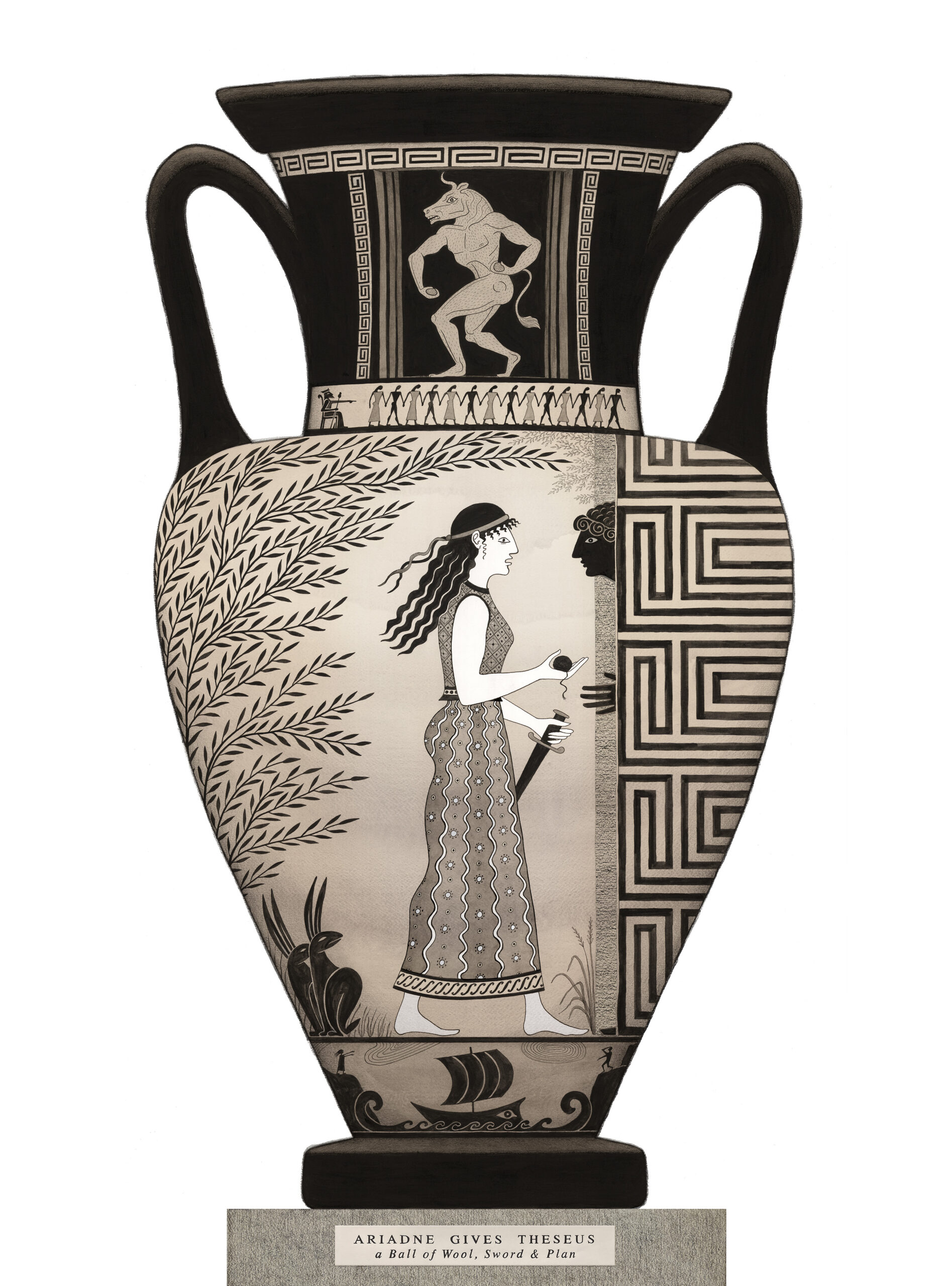
Ariadne gives Theseus a Ball of Wool, Sword & Plan (2026), archival pigment print on Hahnemuhle Photorag, 308g, edition 25, 770 x 570 mm (sheet) $2200 unframed / $2900 framed
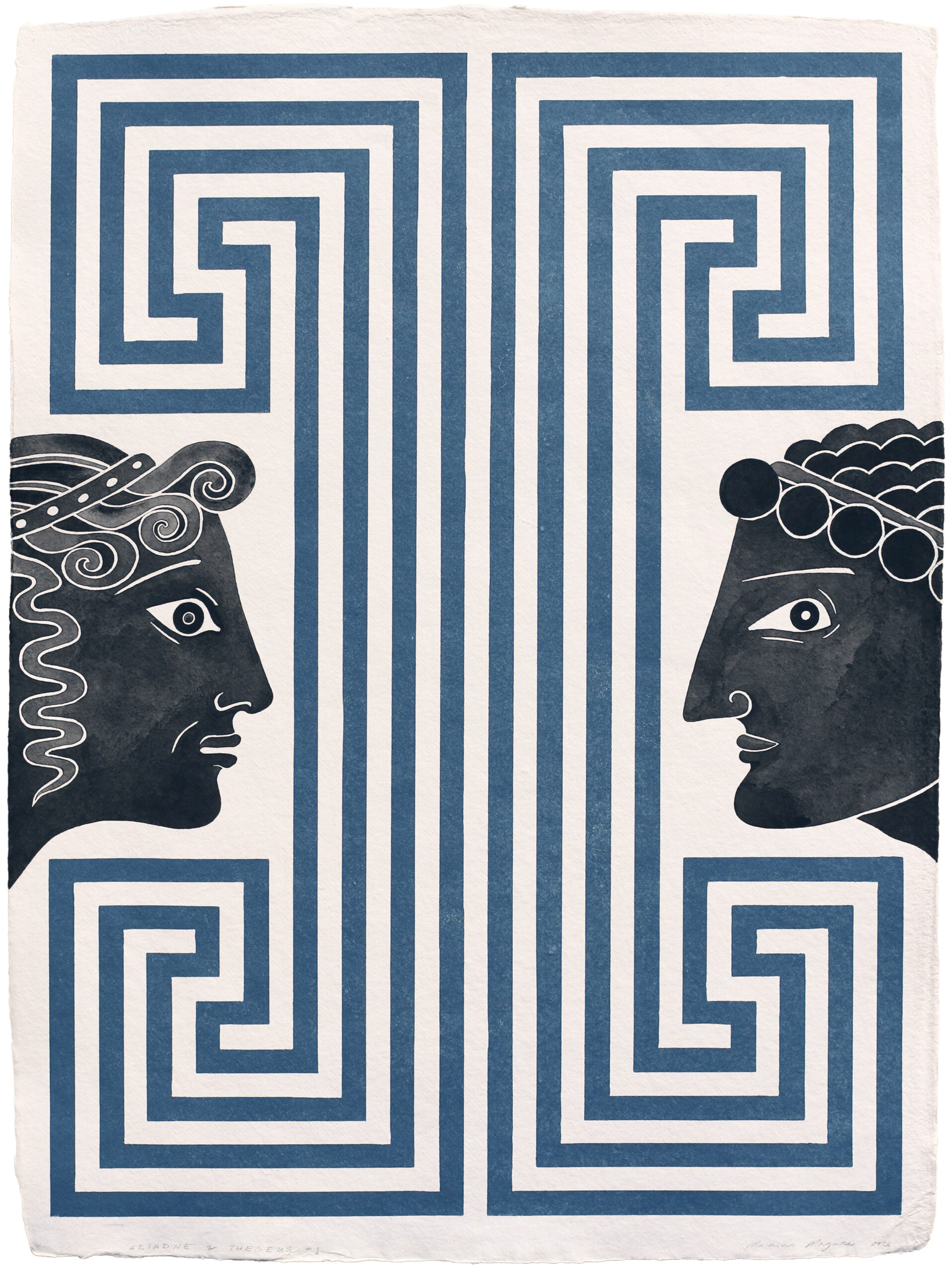
Ariadne and Theseus #1 (2026), acrylic on woodcut print on Khadi Indian handmade paper, 640g, 770 x 570mm, $3000
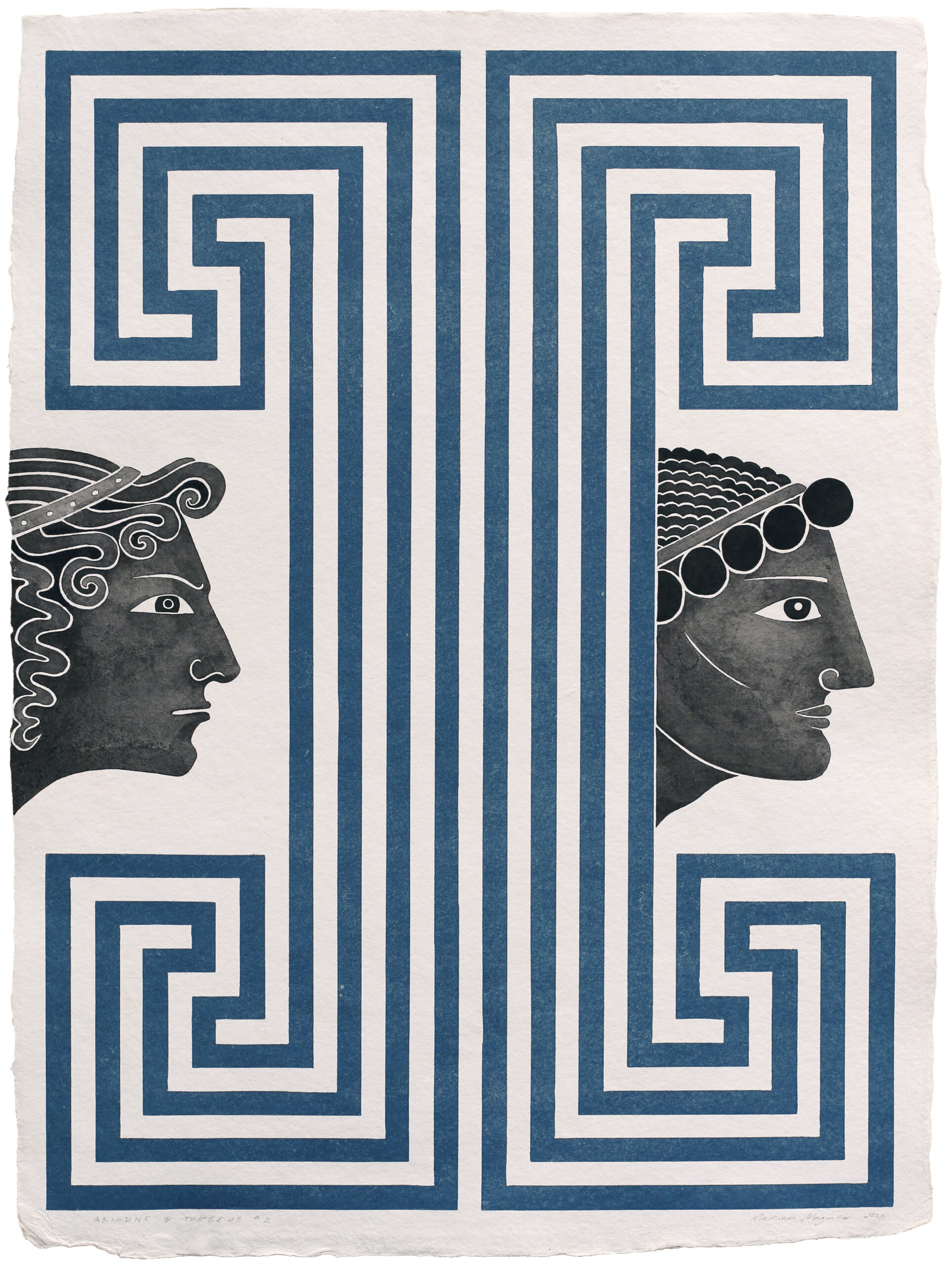
Ariadne and Theseus #2 (2026), acrylic on woodcut print on Khadi Indian handmade paper, 640g, 770 x 570mm, $3000
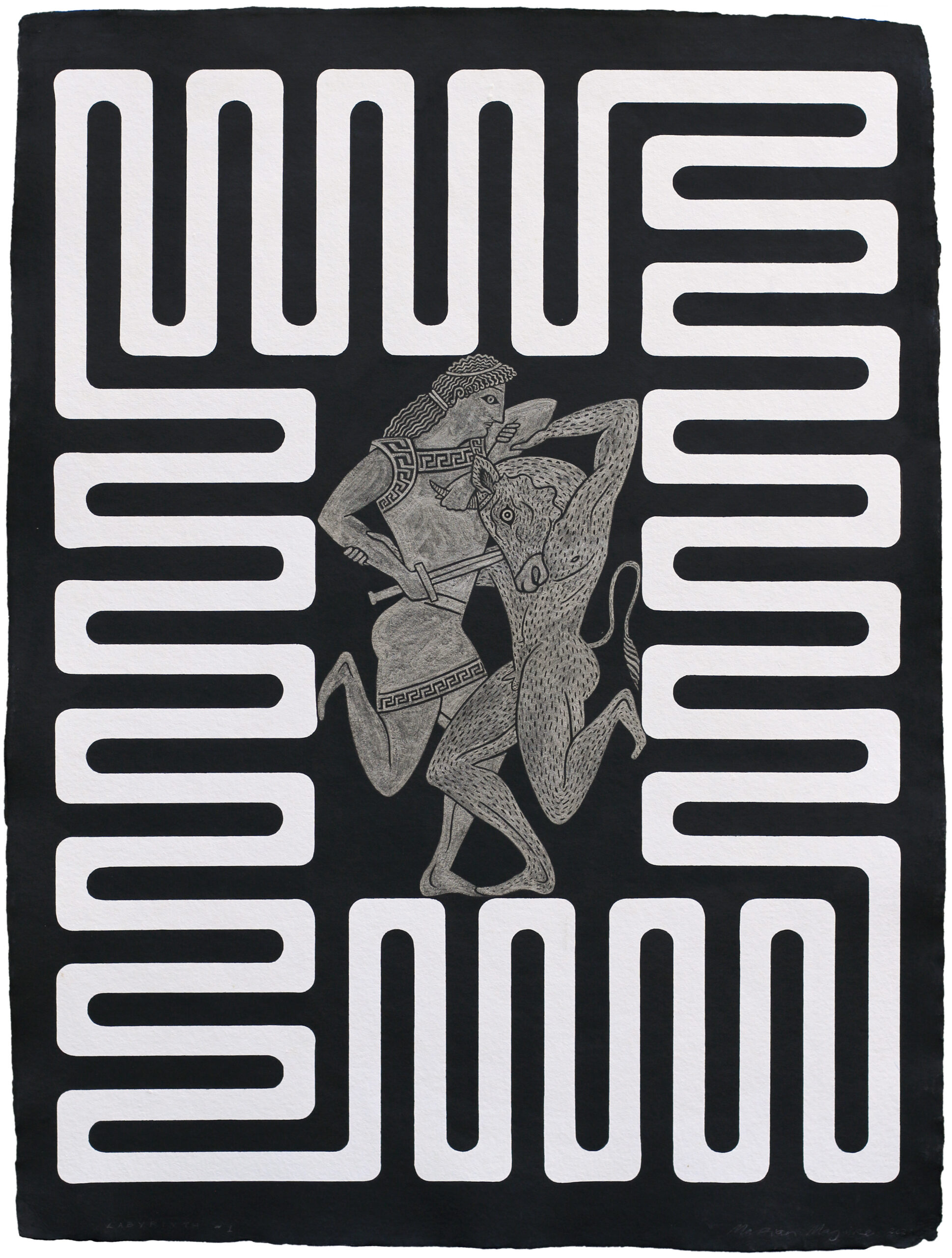
Labyrinth #1 (2026), acrylic on woodcut print on Khadi Indian handmade paper, 640g, 770 x 570mm, $3000
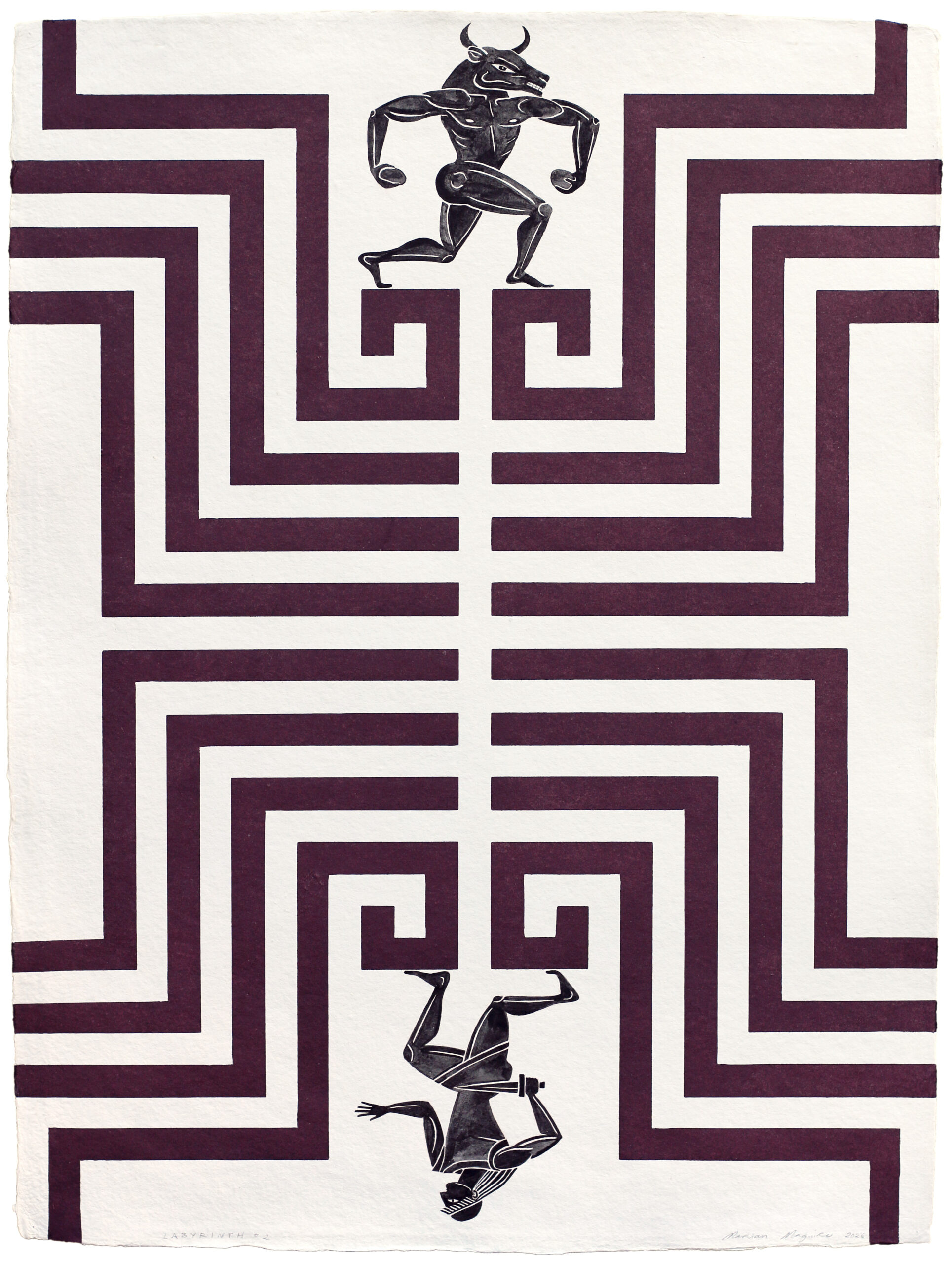
Labyrinth #2 (2026), acrylic on woodcut print on Khadi Indian handmade paper, 640g, 770 x 570mm, $3000
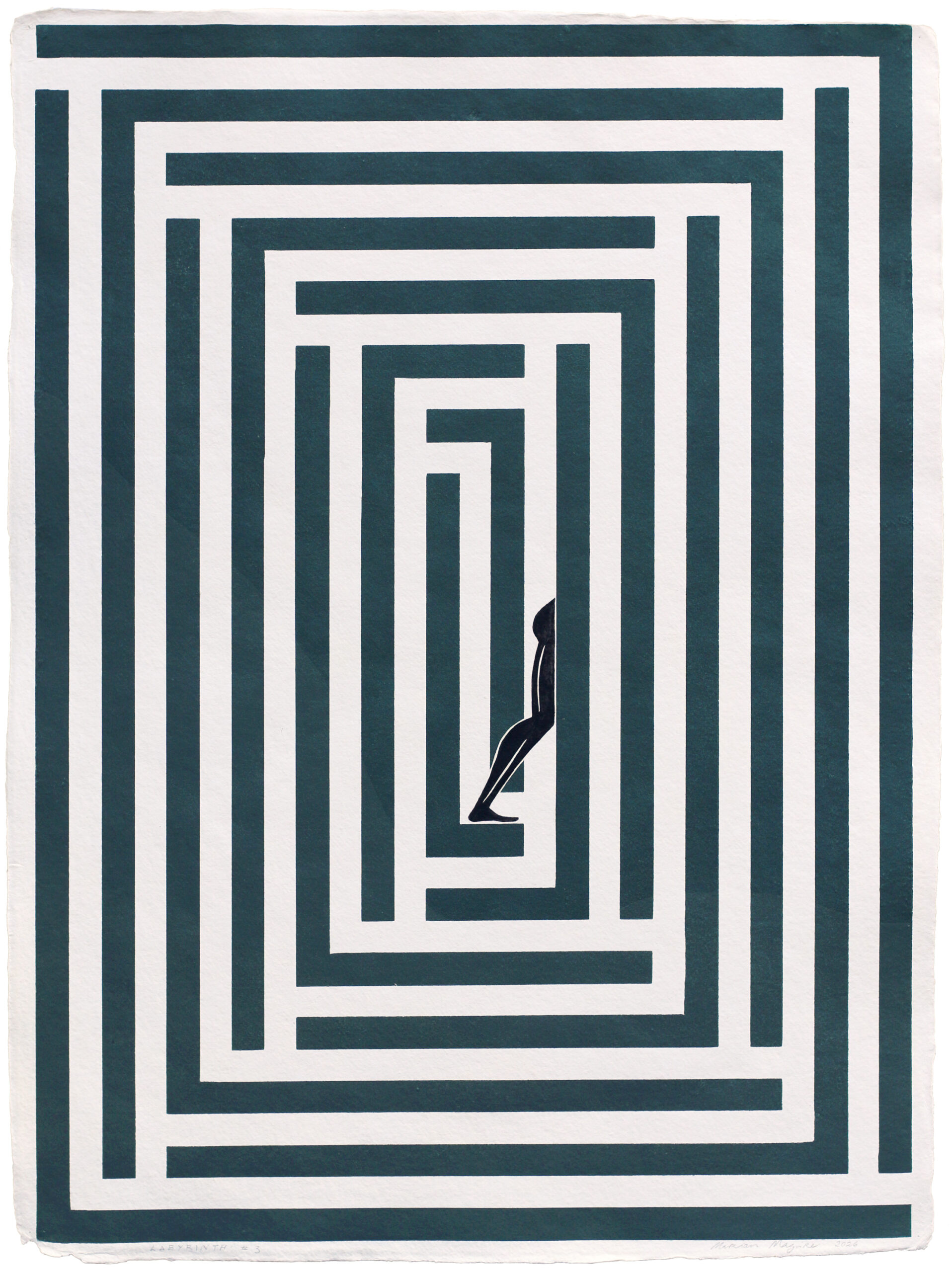
Labyrinth #3 (2026), acrylic on woodcut print on Khadi Indian handmade paper, 640g, 770 x 570mm, $3000
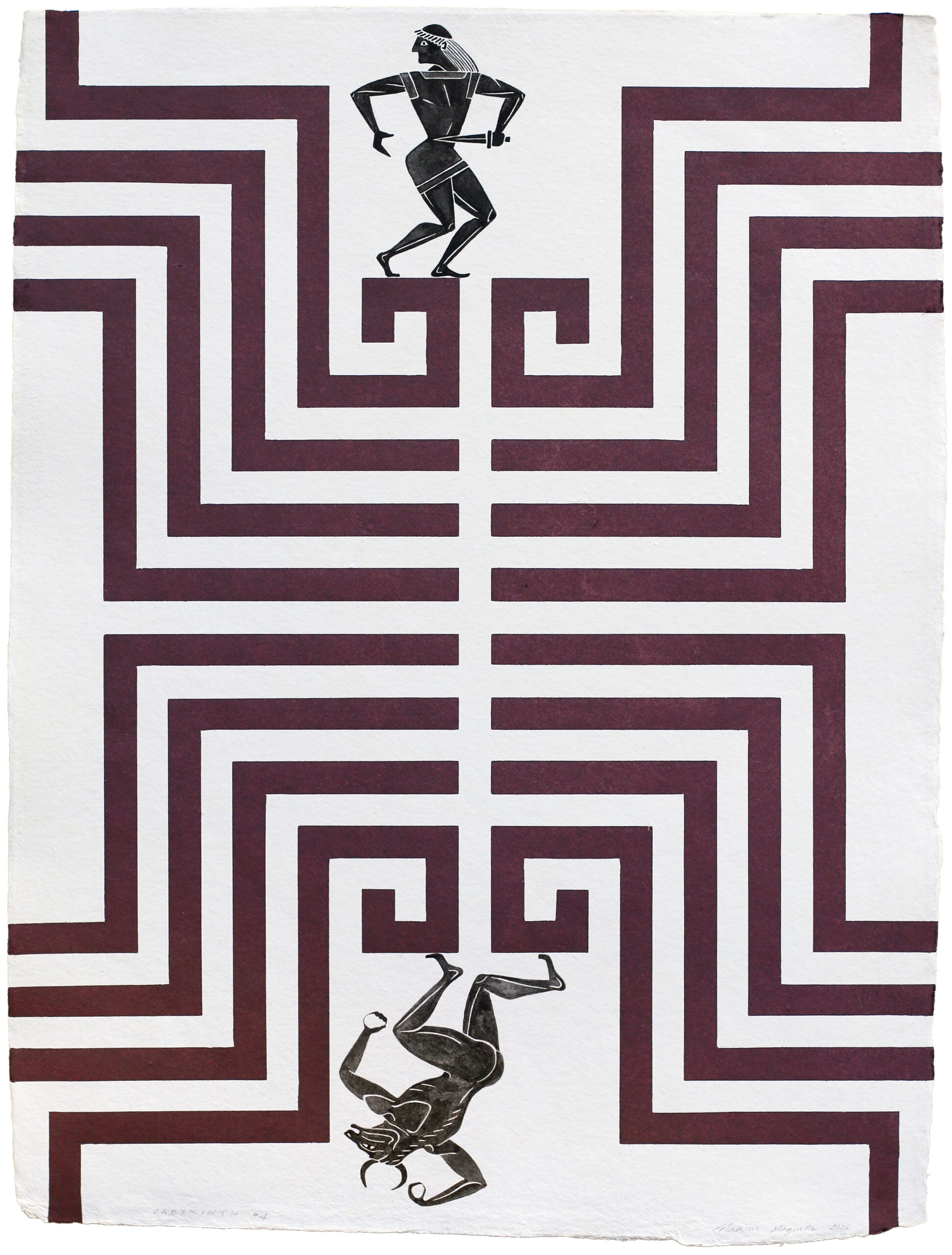
Labyrinth #4 (2026), acrylic on woodcut print on Khadi Indian handmade paper, 640g, 770 x 570mm, $3000
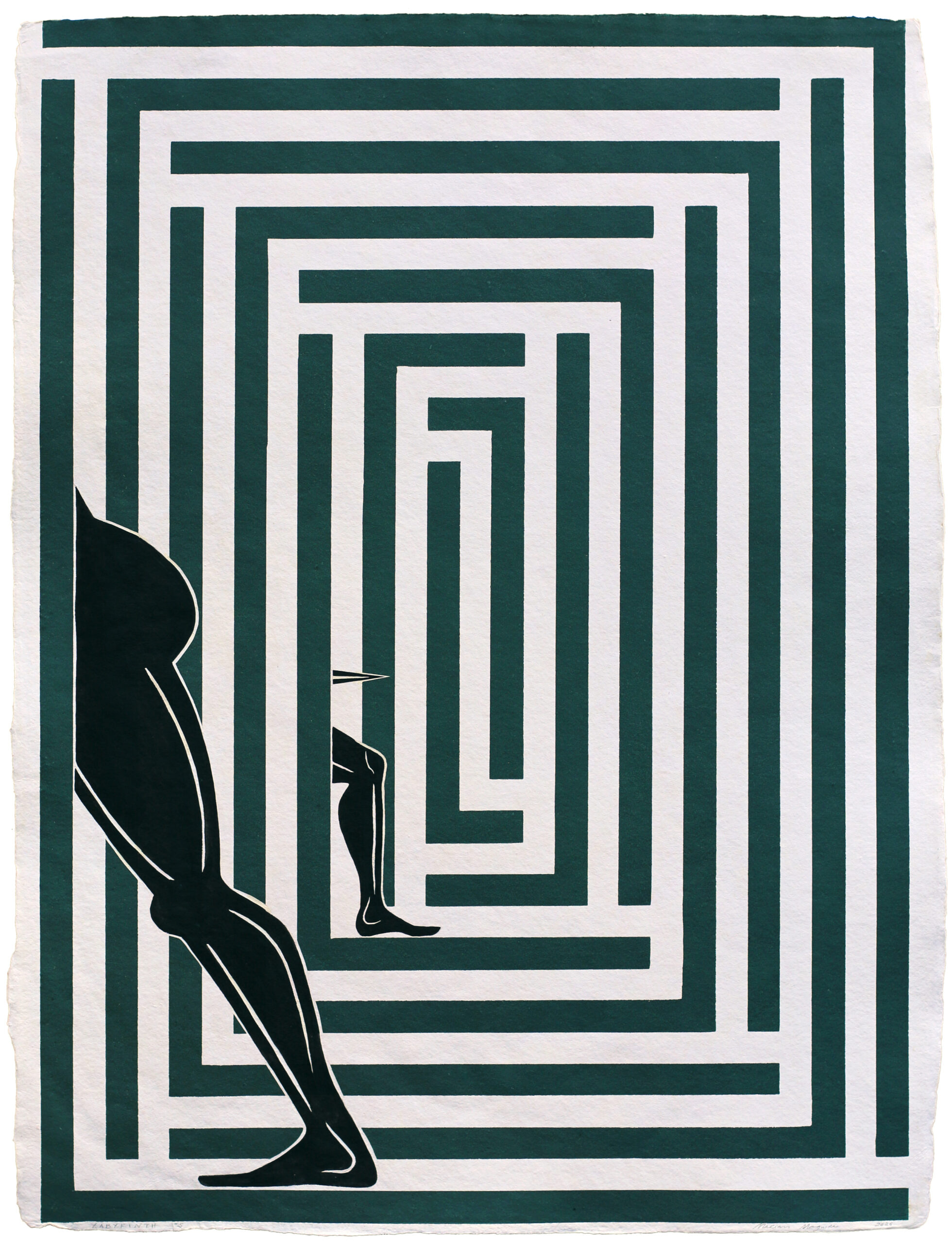
Labyrinth #5 (2026), acrylic on woodcut print on Khadi Indian handmade paper, 640g, 770 x 570mm, $3000
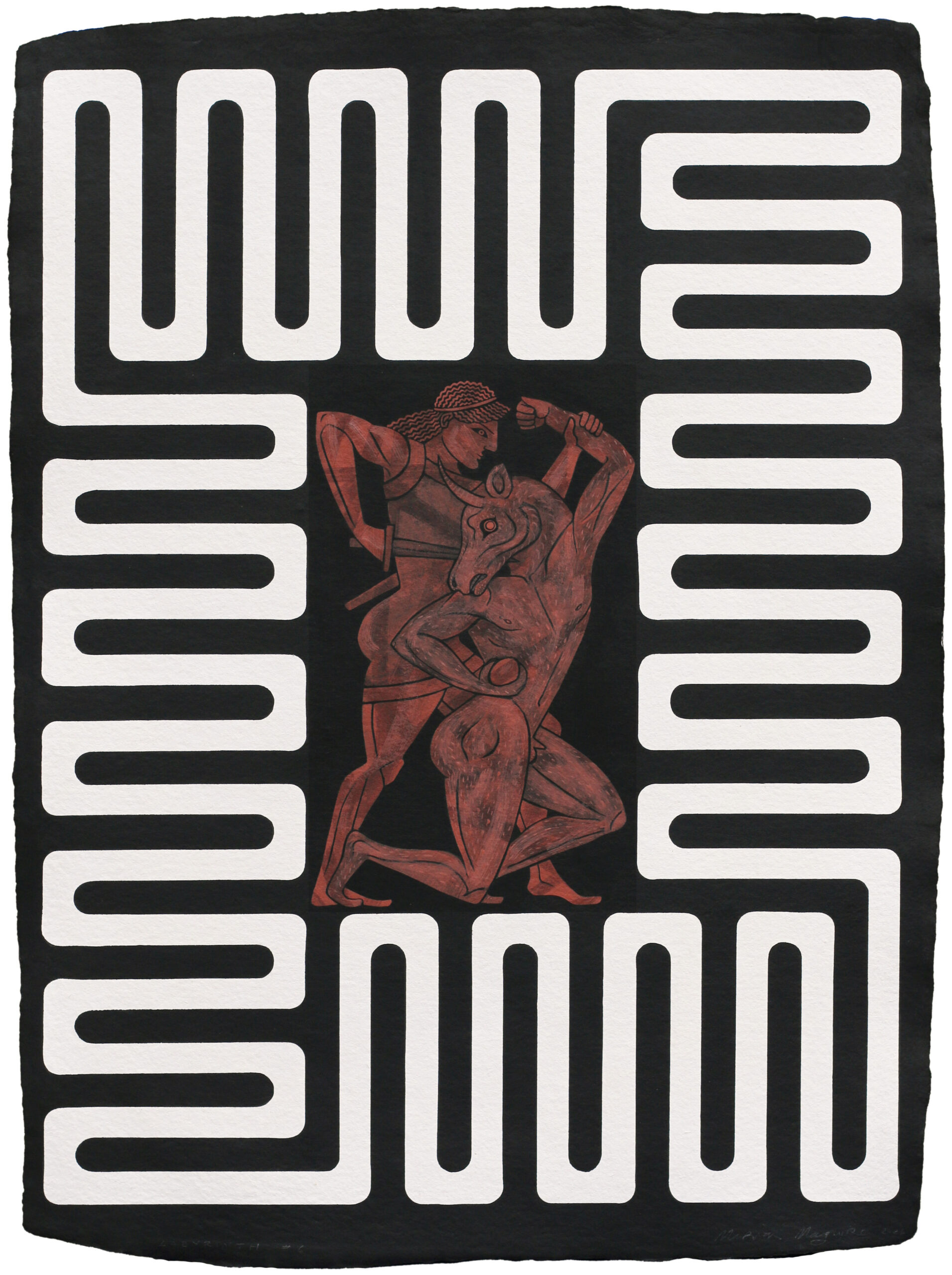
Labyrinth #6 (2026), acrylic on woodcut print on Khadi Indian handmade paper, 640g, 770 x 570mm, $3000